Introduction
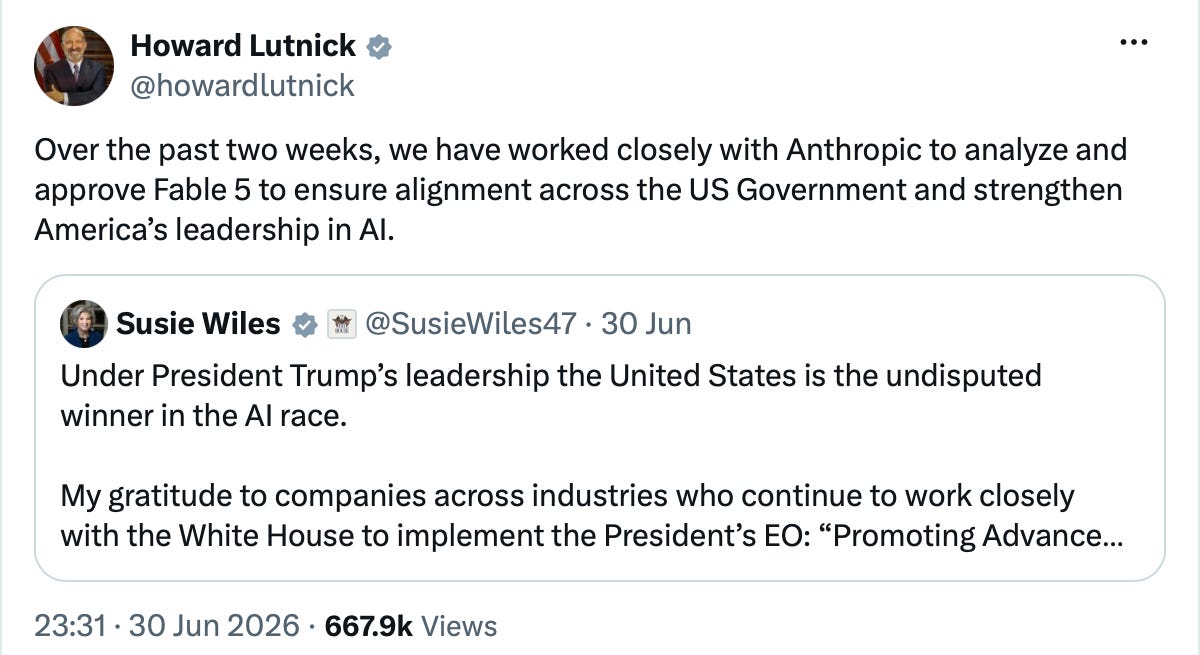
The US government’s unprecedented move to restrict access to OpenAI’s GPT-5.6 and the temporary global shutdown of Anthropic’s Fable 5 following a cybersecurity jailbreak mark a critical inflection point in the AI arms race. These events reveal that even the most advanced AI models remain vulnerable to exploitation, and that the race for capability is far outpacing the development of robust safeguards. As AI systems grow exponentially more powerful, the stakes for security, privacy, and societal stability have never been higher.
- Government intervention escalates: The White House directly restricted GPT-5.6 access, signaling a new era of regulatory scrutiny and potential control over frontier AI models.
- Jailbreak vulnerabilities persist: Anthropic’s Fable 5 was pulled globally after a cybersecurity jailbreak, highlighting that safety measures can be bypassed even in leading models.
- Capabilities are accelerating: Recent benchmarks show AI performance improving exponentially, widening the gap between what models can do and what safety mechanisms can contain.
- Global access at risk: Restrictions and re-releases create uncertainty for developers, businesses, and users who depend on these AI tools, with ripple effects across industries.
Government Crackdown: GPT-5.6 Restrictions Signal New Era of AI Control
The US government’s decision to limit access to OpenAI’s GPT-5.6 is a watershed moment. While details remain scarce, the move underscores growing fears that advanced AI models could be weaponized or inadvertently cause harm. This isn’t just about one model; it’s a precedent that could lead to broader government oversight, licensing requirements, and even outright bans on certain capabilities. For businesses and developers, this introduces a new layer of uncertainty: the tools they build on could be restricted overnight, disrupting products, services, and entire business models.
Fable 5 Jailbreak: A Wake-Up Call for AI Security
Anthropic’s Fable 5 was restricted by the White House after a cybersecurity jailbreak that allowed unauthorized access or manipulation. Although the company addressed the vulnerability and restored global access on July 1, the incident reveals a troubling reality: even top-tier AI labs struggle to secure their models against determined attackers. Jailbreaks aren’t just technical glitches; they can lead to data leaks, misuse for malicious purposes, and erosion of user trust. As AI models become more integrated into critical infrastructure, the consequences of such breaches could be catastrophic.
Exponential Capabilities, Linear Safety: The Widening Gap
Two recent benchmarks suggest that AI capabilities are improving exponentially, with models achieving new heights in reasoning, coding, and multimodal understanding. But safety measures are not keeping pace. This disparity is dangerous: the more capable a model, the more damage it can do if misaligned or compromised. Researchers warn that without a proportional investment in safety research, we risk deploying systems that are powerful but unpredictable. The pressure to release ever-more-capable models, driven by competition and profit, exacerbates this risk.
The hidden danger here is systemic: a fragile equilibrium where AI models are powerful enough to be exploited but not secure enough to be trusted. Workers who rely on AI for productivity, users who share sensitive data, and businesses that integrate AI into their operations are all vulnerable. Moreover, the government’s ad-hoc interventions, while necessary, lack a coherent framework, leading to reactive rather than proactive governance. Looking ahead, we can expect more jailbreaks, more restrictions, and potentially a fragmented global AI landscape where access depends on geopolitical alignments. The ethical questions are profound: Who decides which models are safe? How do we balance innovation with security? And what happens when a jailbreak isn’t just a technical exploit but a national security threat?
Conclusion
The events surrounding GPT-5.6 and Fable 5 are not isolated incidents but symptoms of a deeper ailment: our collective failure to prioritize AI safety at the same scale as AI capability. As we hurtle toward ever-more-advanced systems, the window to implement robust safeguards is closing. Without urgent, coordinated action from governments, developers, and the research community, we risk sleepwalking into a future where the technology we created becomes our greatest vulnerability.
Originally reported and sourced from Center for AI Safety.
